
Charismatic, entwined with the sea and rich with stories and increasingly good food and wine – it’s no wonder Travel Writer Rick Jordan has been visiting the town for years. Here he shares his essential to-dos
Rovinj
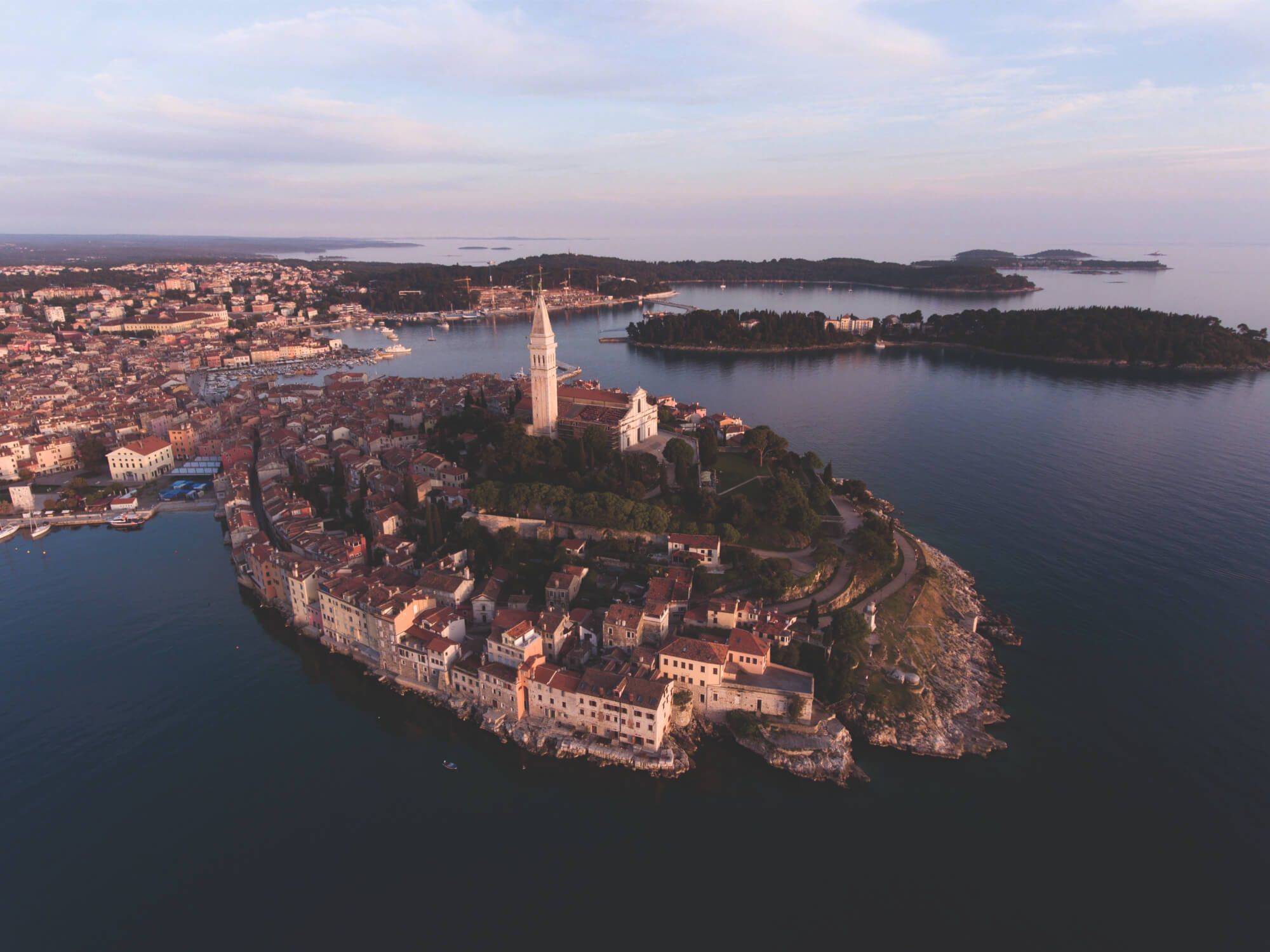
Standing on top of the church of St Euphemia in Rovinj is a statue of the saint whose body turns in the wind like a weathervane – when the wind changes direction, she performs a slow pirouette. Virtually surrounded by the sea, this northern Croatian town feels almost like an island, with medieval streets winding up to its highest point, the church; from her crow’s-nest position, the saint can see out over the ocean for miles.
Set on the Istrian peninsula, Rovinj’s history and culture is salt-crusted, as intricately entwined with the sea as the nets you see gathered in cloud-like bales on the harbour side. Ancient Greek ships sailed here to trade, followed by the Romans; during its time as part of the Venetian Empire its sea captains were renowned for their nautical skills and courage, clashing in battles with the Ottomans and building grand houses with their riches. In the 19th century, steamships sailed here from Trieste, bringing the top-hatted Habsburg elite to their summer houses – now their modern counterparts moor their yachts at the box-fresh marina below the Grand Park Hotel.

I’ve been coming to Rovinj (tempting to pronounce the name to rhyme with ‘hinge’, but actually the ‘j’ is silent and you linger on the ‘n’ with a flourish) for over a decade, drawn back out of season when the crowds from Austria and Italy have subsided, but when the water is still warm enough to dive into, the tables of pavement cafés still fluttering paper menus. It has all the charisma of a Hollywood actor from the 1950s, chiselled in white limestone, capped with terracotta roofs. Walking over the time-polished stone steps of the old town, I’ll pass some familiar sights: the antique diving suit – the sort that you might see in Tintin – welcoming diners at Veli Joze restaurant; the washing hung up like semaphore messages between buildings in the narrow alleys, buzzed by swifts that hurtle past with a screech. At the market, grizzled men order mid-morning glasses of wine at Grota bar, gathered around upturned barrels next to a model of a 19th-century sailing ship, and scorpion fish redden the ice at the fishmongers.Later in the day, I’ll cycle out around the harbour and headland, past the masts of fishing boats that click in the breeze like knitting needles, and freewheel along the promontory, past the Mulini beach club with its navy blue parasols and sunbeds. The trail takes me through a pine forest, and past little coves where idling sunbathers have stacked bleach-white pebbles into teetering cairns. Stripping off, you use the rocks as stepping stones to the sea, launching out into water that’s so clear you can see your toes scrunching over the seabed. Easy to while away an afternoon here, until, with sunset approaching, you cycle back to the old town and make for the Mediterraneo bar, facing west as the sky turns orange and red, watching local teenagers take turns to dive off the rocks and, if you’re lucky, a dolphin or two leaping out of the water.

Where to Eat and Drink
A few years ago, Rovinj was drenched by a storm so wild that the waves crashed over the rocks and left fish stranded on the roof of La Puntulina, the restaurant run by Mirjana and Giovanni Pellizzer. Usually, though, they’re to be found on the plate, smoky from the grill and drizzled with lemon and olive oil – red snapper, sea bream, monkfish, with octopus salad and anchovies before, and perhaps a bowl of handmade Istrian pasta with prawns. The family are deeply embedded in Rovinj – Giovanni’s father used to run Yugoslavia’s first disco here during the communist era, and they’re also behind the Rio Bar, on the harbourside, and the long-standing Giannino Restaurant. There are other tables here, though: I go to Balbi for its vongole, and Brasserie Adriatic for its scallops with sea fennel pesto. In recent years, the familiar seafood joints have been joined by slicker, more stylish outfits such as the harbourside Kantinon Tavern (order the cuttlefish risotto), Articoka (try the pork belly with cuttlefish) and Twin Figs, where creative cocktails such as the house Negroni with Fernet amaro are served alongside brunch and suppers of sea bass tortellini. Unsurprisingly, Rovinj is carving a Michelin reputation for itself, thanks to names such as Monte, set at the foot of St Euphemia’s Church in the family house of Chef Danijel Dekic, who prepares intricate tasting-menu dishes such as lobster mezzalune with carrot fudge; and Agli Amici Rovinj at the Grand Park Hotel, Croatia’s first two Michelin-star restaurant as of 2025, for pretty dishes such as scampi with courgette and courgette flowers, and turbot with seaweed (the vegetable-forward Cap Aureo, in the same hotel, also won a star this year). Istrian wines are among the best in Croatia – no mean feat, considering how much the country’s wine has progressed in the past decade – and several terans (the local reds) and malvazijas (the whites) can be tasted at Vino Vigneto wine bar or straight from the source at the family owned Dobravac Winery.

Romancing the Stone
Beaches, sunshine and sailing, yes; but do many people come to Istria for the geology? They should. Croatia is one of the great karst countries of the world, alongside China, Thailand and Vietnam, with much of its landscape defined by porous limestone sculpted by the elements into dramatic shapes. In Mexico, this erosion creates the underground swimming pools known as cenotes; in southern China, the spiny, stone forests of Shilin. Around Rovinj, it has carved out sea caves, the Lim Fjord and the archipelago of islands just offshore, with bare-knuckle cliffs for jumping off into the water below. There are fantastical inland caves, too, such as the one at Festinsko, and the limestone and dolomite quarry at Kamenolom Fantazija, where trails lead around immense cross-sections of rock, allowing you to see the intricate geological formations. Most dramatic of all, though, is the Pazin Abyss, about a 40-minute drive from Rovinj, where a zipline will take you skimming above a craggy karst landscape that inspired French author Jules Verne.

Songs of the Sea
To misquote Freddie Mercury, flat-bottomed boats make the world go round – or at least they do in Rovinj. Between four or eight metres in length, crafted from spruce and pine – some fluttering a rectangular sail stitched with geometric patterns, others powered by long oars – the batana is the traditional fishing boat of Istria, designed with no keel so as to steer a safe passage around the rocky coastline. But it’s more than a fishing boat: it holds the region’s spirit and soul within its frame. Each summer, a batana is built outside Rovinj’s Batana House Eco Museum (once home to generations of a seafaring family and worth an hour or two of your time) to be launched in September. The boat has its own soundtrack, the bitinada, performed at festivals and out to sea – the Istrian sea shanty, though actually more of a barbershop quartet, the fishermen using their voices as instruments, hitting high and low notes that drift over the water like storm petrels.

Inland or the Islands?
Take a compass bearing. In the autumn, I take a boat out to the islands and alight on Sveti Andrijam, hiring a bike there and circumnavigating this pine-furred islet in less than 20 minutes. A thin causeway leads to its smaller sibling, the almost perfectly circular Crveni Otok; I pedal to the pale stone watch tower at its heart and, climbing the steps to the top, look back across the water to the spire of St Euphemia. Nearby Katarina Island is blanketed with oleanders and conifers, like the overgrown grounds of a country house, with cormorant-blackened rocks guarding its small coves – you clamber over the jumble of strata to swim in the sea, watching ships pass on their way to Rovinj’s harbour. Head in the opposite direction, meanwhile, and hill towns rise up in the forested landscape like islands. Autumn is truffle season, when dogs scuffle for the fungus under the roots of trees and their earthy scent permeates the restaurant menus. Within an hour’s drive from Rovinj are the medieval villages of Vrh and Hum, and Groznjan, with its streets of artists; but best of all is Motovun, its red-roofed houses coiled around the hilltop like a dragon, its high-up stone walls surveying vineyards and forests – best seen over a sundowner drink at the Montona Gallery bar.